CMCC Global and the funds it manages are offered exclusively to professional and accredited investors. They are not available to retail investors.
We are aware that certain unauthorized third parties have been misusing the name “CMCC Global” in connection with purported investments and investment opportunities. Please note that such investments and offers are not affiliated with CMCC Global and are likely fraudulent.
If you encounter or are approached with any investment opportunity referencing CMCC Global or its funds outside of official channels, we strongly advise that you do not engage and instead contact us directly to verify authenticity.
By proceeding, you confirm that you are a professional or accredited investor and understand the above.
The privacy narrative is seeing both a resurgence as well as a transformation within the digital asset ecosystem.
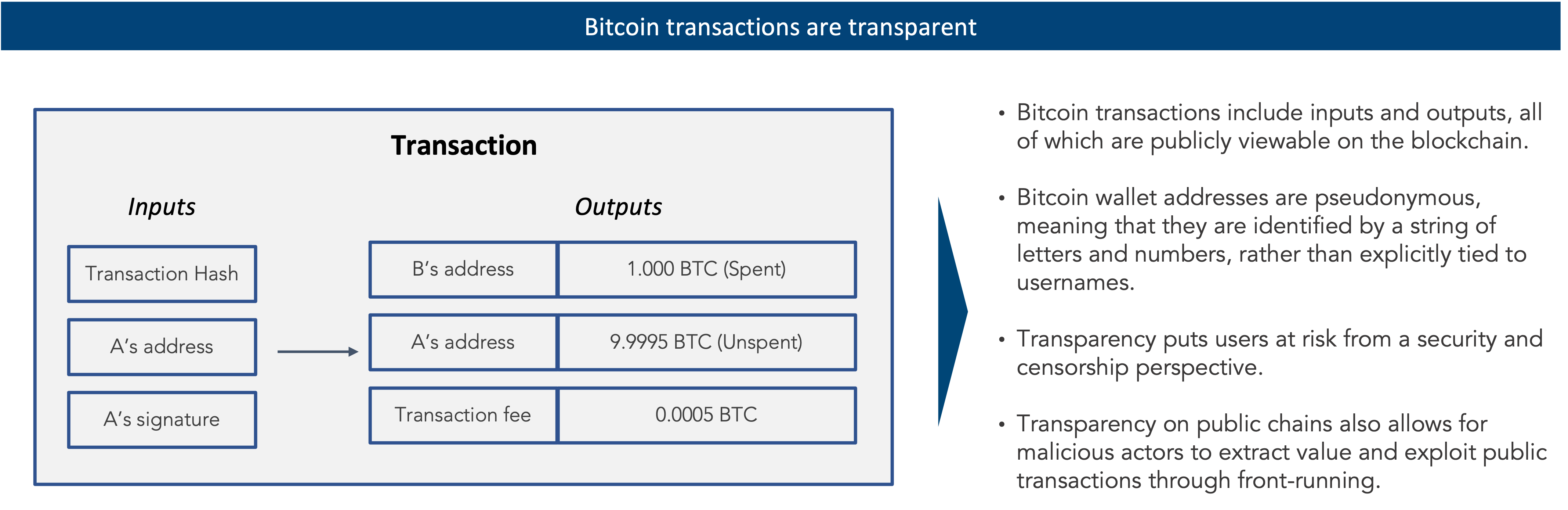
From the earliest days of crypto, privacy was a feature sought by ideological purists. This is highlighted by Bitcoin’s pseudonymous wallet addresses, with wallets identified by a string of letters and numbers rather than a readable and identifiable naming convention. Today, this privacy narrative is back in vogue for more than philosophical reasons. It is now understood that confidential transactions provide additional utility, preventing exploits like transaction MEV (maximum extractable value), and will be required for large scale institutional adoption to take place. This month, we will dig into why privacy is such an important topic for digital assets, we will explain the basics of how it works from a technical perspective and we will evaluate how the resurfacing of this narrative will impact crypto markets.
Privacy has been a staple feature of crypto from the creation of Bitcoin. From a philosophical level, the earliest crypto pioneers believed that there should be freedom to transact without unwarranted oversight. There was an inherent skepticism of the surveillance state and a view that individuals should have the freedom to transact online in the way that they can transact in the real world with cash. Indeed, the Bitcoin white paper is titled “Bitcoin: A Peer-to-Peer Electronic Cash System”, with “cash” being an important word. However, as blockchain analytics improved, it became clear that public ledgers are, in fact, very bad at privacy, with every transaction being broadcast publicly over the network. While the owner of a Bitcoin address may not be known, every transaction that the address has ever completed is viewable.
Broadly speaking, there are two essential problems with public blockchain transparency. Firstly, there is the philosophical issue of publicly tying financial transfers back to individuals and companies. Other than being unpalatable and a security and safety risk, transparency of wallet ownership can severely limit individual and corporate freedom because of censorship by central authorities or malicious actors. On the individual side, dystopian censorship can already be seen happening in digital payments, with examples from China to Canada. On the corporate side, public transactions can be monitored by competitors, making public crypto payment mechanisms unusable for businesses in competitive industries. Protocols that prioritize “privacy by design” are not only technological advancements, but also manifestos for reclaiming user control, corporate privacy and digital human rights.
The second issue with transparent blockchains is the value extraction that can take place through MEV (maximal extractable value). When transactions are submitted to public blockchains, they enter a memory pool (mempool), which exposes the pending transaction details and user trading intentions. This transparency window is exploited by sophisticated actors known as “searchers” or “bots”. These actors can front-run transactions or conduct other predatory reordering practices to make money. For example, a sandwich attack is a simple strategy whereby a bot will insert a buy order before a user transaction and a sell order immediately after the transaction, thereby making a guaranteed return from witnessing a trade before it is executed. MEV is a hidden tax on network activity and, over the long, run erodes user trust. It makes high-value institutional trading strategies financially untenable on public chains. Private transactions are the solution to this problem.
By the mid-2010s, the realization that Bitcoin is not privacy preserving led to the creation of the first wave of privacy coins. Developers began creating new protocols, leading to the emergence of specialized privacy-focused assets, the most prominent early examples being Monero and Zcash. Monero focused on confidential and censorship-resistant transactions, achieving anonymity by concealing the sender, receiver, and amount of every transaction using Ring Signatures, Stealth Addresses, and RingCT. Ring Signatures blend and mix a user's transaction with those of several others to obscure the true sender; Stealth Addresses generate a unique, one-time receiving address for every payment to hide the recipient; and Ring Confidential Transactions (RingCT) cryptographically conceal the value of the asset being transferred.
As Monero was gaining traction, Zcash then launched in October 2016 using zero knowledge proofs (ZKPs), or more specifically, ZK-SNARKs (Zero-Knowledge Succinct Non-Interactive Argument of Knowledge). This cryptographic primitive allows a party to verify the truth of a statement without revealing the underlying data. For example, you could use a ZKP to assert that you have between USD1,000 and USD2,000 in a wallet, without revealing the wallet balance. From a functionality perspective, this is more useful and sophisticated than the privacy that Monero provides. The use of ZKPs means that users can selectively disclose information about their wallets, which may be useful for both confidentiality and compliance.
While Zcash is seeing a substantial resurgence in trading activity and price, there are newer protocols that are incorporating more sophisticated privacy technology and reimagining privacy at the application and network level. Anoma, a portfolio company that we originally invested in back in 2021, is a new leader in creating novel privacy technology, with a radical approach to architecture that includes composability across different chains. Anoma is not a traditional blockchain, but a decentralized “intent-centric” protocol. Rather than processing a single sequence of transactions, Anoma is a framework for expressing and fulfilling intentions across multiple chains. In simpler terms, Anoma lets users state what they want to achieve (their intent) and then handles the discovery of counterparties and execution path in a private and decentralized manner.
Privacy is a cornerstone of Anoma’s design. The protocol uses advanced cryptography (Halo 2 zero-knowledge proofs) to ensure that intents and transactions remain secure and private. The architecture is built such that much of the processing and matching of user intents happens off-chain in a network of “intent gossip” nodes and solver nodes, which can negotiate and compose transactions without exposing sensitive details on a public ledger. When a final transaction settlement does occur onchain, it is done in a minimized form with cryptographic proofs, revealing only what is necessary. This approach allows Anoma to offer a high degree of privacy by default. Users retain control over what information is shared and with whom during the process of fulfilling their intents. Notably, Anoma’s vision extends to interoperability: it aims to be a unifying layer that can connect multiple ecosystems (Ethereum, Cosmos, Bitcoin, etc.) while preserving privacy and composability across them. By aggregating intents globally and enabling cross-chain matches, Anoma could break down the silos of current blockchain applications, all while keeping user data confidential. This is a grand vision that could impact how crypto transactions are executed.
Another of our portfolio companies that is innovating in the privacy space is Nockchain, which is a Layer 1 secured by a novel Zero-Knowledge Proof of Work (ZKPoW) consensus mechanism. Nockchain marries the original cypherpunk ethos of PoW mining with cutting-edge zero-knowledge technology to create a scalable and privacy-enhanced blockchain. In Nockchain’s consensus, miners do not compete to find random hashes as in Bitcoin; instead, miners must generate zero-knowledge proofs of solving a computation puzzle, which then serve as proofs-of-work for block production. This approach turns mining into a process of proving useful computation, described as “useful proof-of-work.” By replacing wasteful hash brute-forcing with the generation of ZK proofs, Nockchain aims to secure the network while simultaneously producing verifiable computations that can be useful for the system.
In addition to enhanced privacy, Nockchain’s architecture is designed for full programmability. It introduces a novel virtual machine (the Nock VM) that allows developers to write smart contracts. However, unlike traditional smart contract platforms, Nockchain minimizes onchain execution: the heavy lifting of contract computation is done off-chain by parties who then post a succinct proof to the blockchain. This means applications built on Nockchain can achieve high throughput without burdening every node with every computation. The network only needs to verify the correctness via a ZK proof, which is lightweight to check. The benefit of this model is twofold: scalability (since off-chain computation can be as large as needed) and privacy. Zero-knowledge proofs on Nockchain ensure that only the information necessary to validate a transaction is made public, and nothing more.
For investors, protocols like Anoma and Nockchain represent a convergence of old and new. They utilize the useful feature set of traditional blockchains, while infusing it with zero-knowledge technology to address modern demands of scalability and privacy. They offer superior functionality to older privacy protocols like Monera and Zcash, while building off the technology that these earlier projects pioneered. This makes the newer breed of privacy platforms more practical as the backbone for the modern open financial system.
At a time of geopolitical uncertainty and growing mistrust of governments and institutions, the desire for financial privacy and uncensorable digital cash is likely to increase. Within this context, the rise of privacy as a theme within the digital asset markets cannot be ignored. Just as past narratives such as DeFi and NFTs produced outsized winners, the privacy narrative is already showing evidence of capital inflows and has decorrelated with the broader crypto market over the past month. While much of the price performance has so far been centred around older and more established projects like Zcash, the technological advances of newer privacy platforms make them well placed to gain attention and adoption. At CMCC Global, we are excited by the renewed attention on the privacy narrative and view our early-stage investments in Anoma and Nockchain as high potential positions. The concept of “privacy by design” is likely to become standard rather than an exception, and we are positioned to capture the value of this narrative in the coming years.