CMCC Global and the funds it manages are offered exclusively to professional and accredited investors. They are not available to retail investors.
We are aware that certain unauthorized third parties have been misusing the name “CMCC Global” in connection with purported investments and investment opportunities. Please note that such investments and offers are not affiliated with CMCC Global and are likely fraudulent.
If you encounter or are approached with any investment opportunity referencing CMCC Global or its funds outside of official channels, we strongly advise that you do not engage and instead contact us directly to verify authenticity.
By proceeding, you confirm that you are a professional or accredited investor and understand the above.
Perpetual decentralized exchanges (perp DEXs) have proven product market fit over the last couple of years, generating USD7.9 trillion in volume in 2025, a 3x increase from 2024. The next step is for these exchanges to be regulated and compliant, which is where our portfolio company Rails is leading the way in the US.
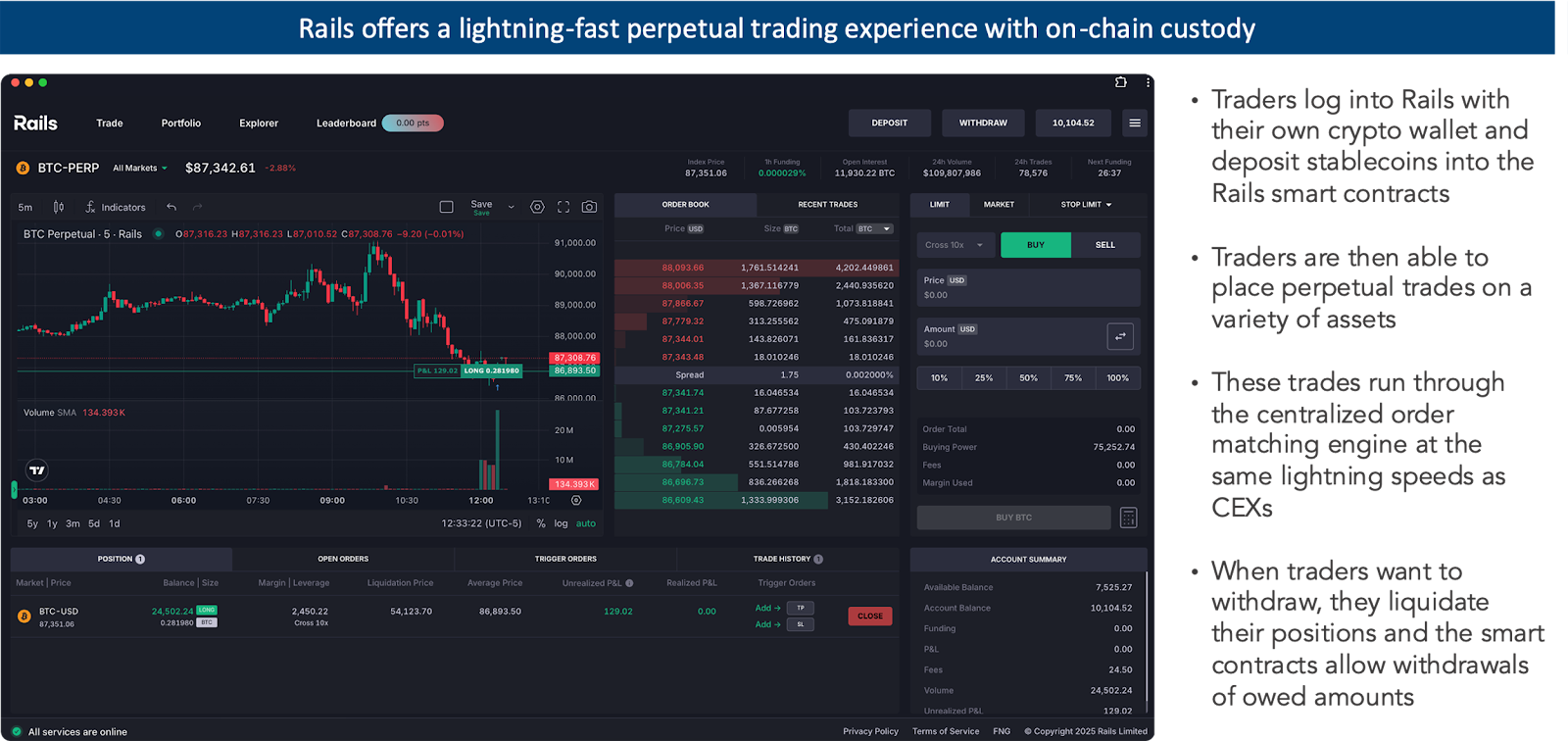
The Rails platform blends the execution speed of centralized exchanges (CEXs) with the self-custodial security of DEXs. This combination addresses the key pain points of both centralized exchanges (hacks and mismanagement) and DEXs (slow settlements and low liquidity). The next step to institutionalisation is for leading perp DEXs to become fully compliant and regulated. This month, we will provide a refresher on what Rails is and how it is perfectly positioned to dominate in the upcoming regulated perp DEX arena.
We first wrote about Rails in March 2025. Back then we introduced Rails as a hybrid perpetuals trading platform poised to bridge the gaps between centralized efficiency and decentralized security. At that time, the project had not yet gone live, although many of the technical innovations and much of the engineering work was underway with the build out of self-custodial smart contract wallets and a hybrid order execution engine for sub-millisecond trades. The team led by CEO Satraj Bambra (co-founder of BlockEQ, acquired by Coinsquare), CTO Megha Bambra (former VP at Grindr through its IPO), COO Rick Marini, and General Counsel Brent Vegliacich (ex-EY and Reed Smith), combine both deep technical expertise with business acumen. Before the platform had even launched, Rails had assembled partnerships with institutional market makers like Flowdesk to ensure deep liquidity.
Fast-forward to today, Rails has not only launched but has matured into a regulated derivatives and trading infrastructure powerhouse. Since its public launch in June 2025, the platform has processed over USD3.4bn of trade volume, while maintaining constant platform availability. The platform’s volume highlights that it is gaining traction and can handle substantial trading activity. Its uptime reflects the platform’s resilience, which stems from its modular architecture: centralized matching for speed, onchain custody via EVM-compatible smart contracts, and zero-knowledge proofs for private, verifiable transactions. Users retain control of their assets, eliminating third-party risks that plagued platforms like FTX.
While Rails has achieved an impressive start to its operating life, the reality is that there are numerous crypto exchanges around the world that have perpetual futures offerings. Rails is operating in a highly competitive market and understands that it needs to differentiate to thrive. This is why Rails has decided to embrace the recent shift in US regulatory sentiment towards crypto.
Today, Rails is registered with the Cayman Islands Monetary Authority (CIMA) under both Virtual Asset Service Provider (VASP) and Securities Investment Business Act (SIBA) regimes. This was the case from day one, as Rails is one of the few crypto platforms designed for compliance at its core. The next step for serious perp DEX platforms is to become fully regulated in the US. Rails is the first venue to have a pending NFA registration with the CFTC, which will pave the way for compliant access to the US market. In 2025, the regulatory climate shifted significantly with agencies like the SEC and CFTC realigning to focus on fraud prevention while providing "safe harbours" for good actors who operate with transparency. For institutional investors, the pending NFA registration is a signal of maturity, transforming Rails from a niche DeFi protocol into a financial-grade exchange infrastructure provider.
The regulatory moat that Rails has created is becoming a huge asset for the platform and is something that most DEXes simply cannot achieve due to stringent licensing, custody, and KYC requirements. The benefit for Rails is in the form of partnerships and the newer idea of Crypto-as-a-Service (CaaS). Large-scale financial platforms, such as neobanks and brokerages, are increasingly looking to offer crypto derivatives to their users to boost engagement and revenue. However, these entities are legally prohibited from integrating with unregulated venues. Rails addresses this barrier by providing the regulatory foundation and the execution layer through a single integration.
For example, a neobank in the US may want to offer its clients Bitcoin perpetuals and options trading products, without having to build its own matching engine or acquire complex derivatives licenses itself. Rails can step in as a partner for this bank through offering a CaaS fee-sharing model. This is a win-win for both Rails and neobank; the partner brings users and trading volumes, while Rails provides the compliant backend, and both parties share in the trading fees.
As well as having the licences required to offer CaaS to other financial platforms, it is crucial for Rails to continue growing its liquidity to provide an exceptional trading product with tight spreads across the markets it offers. Liquidity is the lifeblood of any derivatives platform. Rather than adopting the standard crypto practices of a "vampire attack" or "incentive farming", Rails is building a more sustainable "Institutional Vault" system to grow liquidity. Central to this strategy is a partnership with the Stellar Development Foundation (SDF). Stellar has quietly become a major player in the tokenization of real-world assets (RWAs), with over USD3bn in RWA value on the network. Rails has partnered with Stellar to build vaults that are seeded by the Stellar Treasury. This allows Rails to act as a liquidity provider when offering its platform as a service to other platforms. Rails can use collateral deposited in its vaults to help make markets and tighten spreads, whilst providing a return for the vault lenders.
In summary, Rails has a vision to become the compliant backend that powers the crypto derivatives offerings of the world's leading fintechs and institutions. The path to scale is clear:
Integration partners bring users: By plugging into existing platforms (e.g., neobanks, brokerage apps), Rails avoids the high cost of direct retail user acquisition.
Vaults bring liquidity: Partnerships like the one with Stellar ensure that the platform has the depth required to attract professional traders and minimize slippage.
Revenue through trading fees: Rails takes a percentage of every trade executed across its network of partners and vaults, creating a highly scalable, high-margin revenue model.
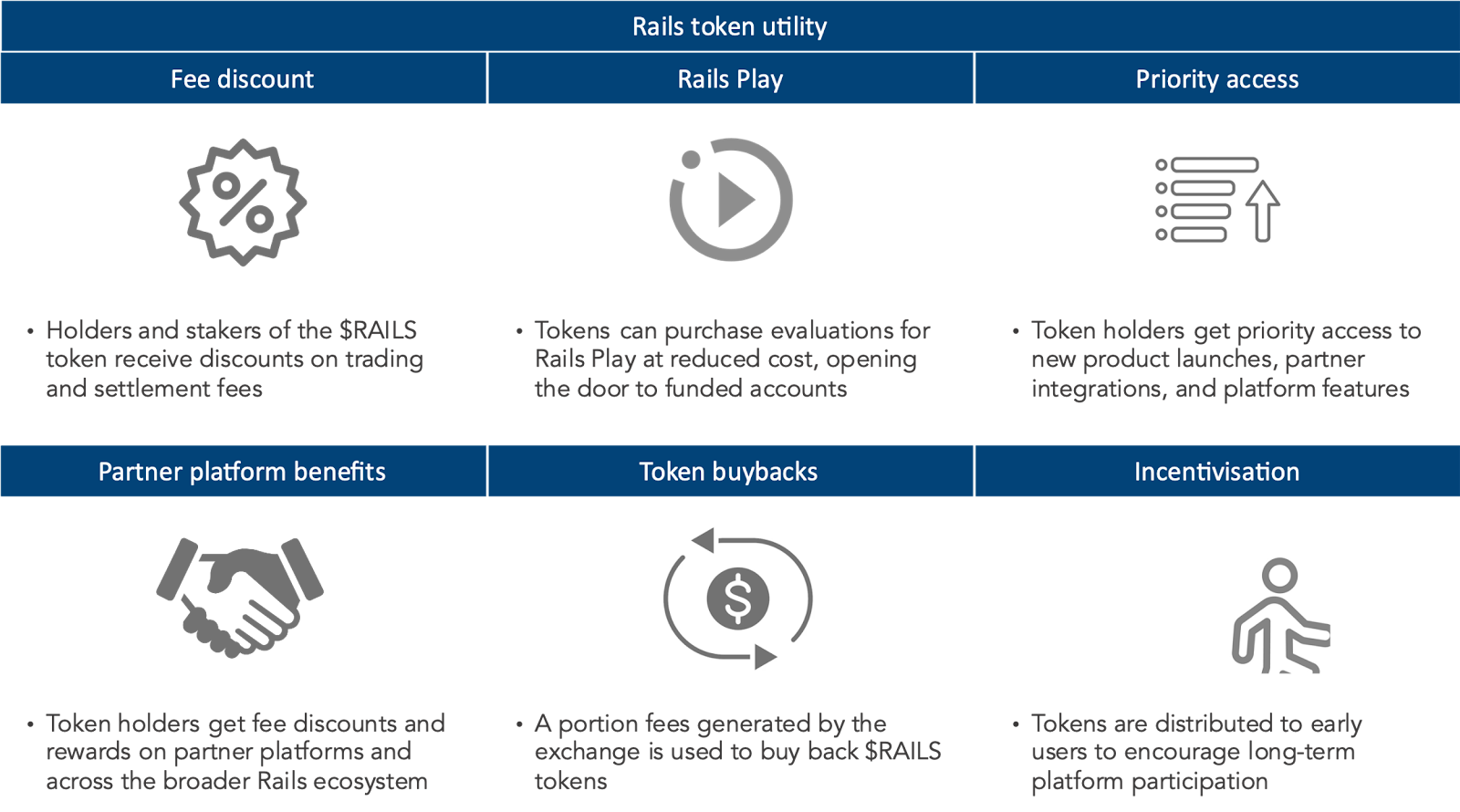
On February 4th this year, Rails will launch its token with a fixed supply of 65m tokens. The key differentiator of the token is its utility. It is intentionally designed for long-term sustainability, not short-term hype. The purpose of the Rails token (RAILS) is to provide utility within the trading platform, and it has several functions to incentivize participation and align the interests of traders, institutions, and the community:
Trading fee discounts: Similar to other trading platforms like Binance, holders and stakers of the RAILS token receive tiered discounts on trading fees incurred on the platform and participating partner platforms. Larger holdings unlock progressively lower fees, rewarding long-term participants and active traders.
Settlement fee discounts: Token holders benefit from reduced settlement costs on trades executed through Rails infrastructure. This is applicable across both direct and partner integrated platforms.
Rails Play integration: Rails Play is an educational training ground for new traders. Rails Tokens can be used to purchase evaluations at reduced cost. Successful completion of an evaluation paid with Rails Tokens may unlock enhanced rewards and priority access to funded accounts.
Priority access: Token holders will receive priority access to new product launches, partner integrations, and platform features.
Partner platform benefits: As institutional partners integrate Rails, token utility extends to their platforms. This enables fee discounts and rewards across the broader Rails ecosystem.
Deflationary mechanism: A portion of the fees generated by the exchange (10% of trading fees quarterly) is used to buy back RAILS tokens from the open market. This continuous buy pressure should increase the token's value over time.
Incentivization: Tokens are distributed to early users and active traders through various campaigns and competitions to encourage platform use and long-term participation.
As investors in Rails through both our Digital Asset Funds and Titan Fund, we are thrilled by the progress the team has made and are excited by the upcoming initiatives and token launch. We foresee the inevitable institutionalization of digital assets and Rails is perfectly placed to take advantage of this through its thoughtful innovation and regulatory foresight. While retail-focused exchanges compete on memes and marketing spend, Rails has chosen the harder, more defensible path of "Regulation, Performance, and Infrastructure". Derivatives are the largest financial market in the world and the transition of this market onchain is a multi-decade trend with regulation as the gatekeeper. Only platforms that are compliant will be able to serve the trillions of dollars in institutional capital currently sitting on the sidelines. We are excited to see Rails become a cornerstone of the next wave of global financial architecture.