CMCC Global and the funds it manages are offered exclusively to professional and accredited investors. They are not available to retail investors.
We are aware that certain unauthorized third parties have been misusing the name “CMCC Global” in connection with purported investments and investment opportunities. Please note that such investments and offers are not affiliated with CMCC Global and are likely fraudulent.
If you encounter or are approached with any investment opportunity referencing CMCC Global or its funds outside of official channels, we strongly advise that you do not engage and instead contact us directly to verify authenticity.
By proceeding, you confirm that you are a professional or accredited investor and understand the above.
Within days of the announcement, Genius trading volumes exploded from below USD100m to over USD2bn. The investment also signalled that crypto trading is evolving and entering its second act. For more than a decade, centralized exchanges (CEXs) like Binance, Bybit, and OKX have dominated trading volumes by offering speed, liquidity, and convenience. However, this came at the cost of custody risk, opaque practices, and growing regulatory friction. In response, decentralized exchanges (DEXs) have been gaining market share as traders demand self-custody, transparency, and composability without sacrificing performance. We wrote about this trend back in October 2024, and given the incredibly positive developments at Genius, we will revisit the theme again this month.
CEXs and DEXs
In the original Ethereum whitepaper, Vitalik cited decentralized exchange as one of the first applications for blockchains beyond merely being a medium for the transfer of money. Yet for much of the past decade, this vision remained largely theoretical. Despite data showing that trading is the primary activity users engage in on the blockchain, on-chain trading remained slow, fragmented, and challenging at scale. Centralized exchanges filled this gap, delivering speed and liquidity, but only by re-introducing trusted intermediaries. The result was a market built on a contradiction: the activity users most wanted to do on-chain was serviced by centralized companies off-chain.
There are several reasons why centralized exchanges have remained the dominant venue for trading across the industry.
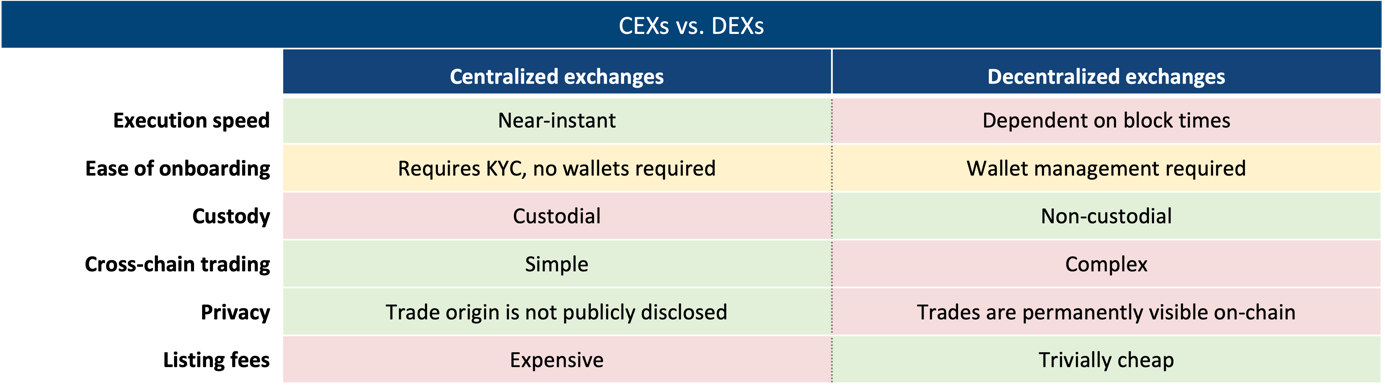
Firstly, they solved the two hardest problems in trading early on: liquidity aggregation and execution speed. By pooling users into a single order book and operating off-chain matching engines, CEXs delivered tight spreads, deep markets, and near-instant fills, conditions that early blockchains could not support. For active traders, especially those running high-frequency or market-making strategies, this performance gap mattered far more than ideological commitments to decentralization.
Secondly, CEXs lowered the cognitive and operational burden of trading crypto. Account creation felt familiar, interfaces mirrored traditional finance platforms, and users could trade across dozens of assets and chains without thinking about wallets, gas fees, or bridge mechanics. For institutions and retail users alike, centralized venues offered a one-stop shop that made crypto usable at scale long before on-chain alternatives were ready.
Finally, network effects reinforced the CEX behemoths. Liquidity begets liquidity, deeper order books attracted more traders, which in turn tightened spreads and increased volumes further. Listing on a major CEX became a milestone for new tokens, pulling users and activity towards the same few venues
On the other hand, centralized exchanges presented some material risks which users reluctantly accepted. The most well-known risk was custody risk. Whenever users deposited crypto to a CEX, they ceded control over that asset to the exchange. This risk was directly linked to some of the most disastrous events in crypto history, including the collapse of FTX in 2022, Mt. Gox in 2014, and QuadrigaCX in 2019.
A more subtle downside to centralized exchanges is their role as gatekeepers to liquidity, allowing them to exercise monopolistic power by demanding exorbitant fees for tokens to get listed. These practices drew particular attention in October last year. Jeffy Yu, the founder of AI/music project Zerebro, revealed that Binance requested USD1m in cash for listing. Similarly, Bybit requested a “large amount of tokens” along with USD250k. These claims were mirrored by CJ Hetherington, the founder of Limitless Labs, who stated that Binance charged him 8% of his project’s total token supply along with a USD250k cash payment to get listed on the exchange. Compared to DEXs where the cost of “listing” is practically free, many in the space see these CEX fees as extractive
DEXs embody crypto’s original ethos of transparency and trust-minimization. Anyone can create a token pair or liquidity pool and traders can swap tokens directly from their wallets. The result is a flourishing ecosystem where innovative tokens often debut on-chain at virtually no cost. For scale, Uniswap, one of the longest standing DEXs on Ethereum, has facilitated over USD3.5tn in volume since its inception. Pump.fun, a popular token launchpad on Solana that enables anyone to issue a token with no code, has issued more than 16m new tokens on its platform.
Just like CEXs however, DEXs face three major challenges that have inhibited their long-term adoption:
The on-chain onboarding experience is cumbersome. DeFi interfaces assume that the end user is already set up with a wallet and often requires the user to manually adjust their slippage and manage gas fees. Data shows that 60-90% of users drop out before making their first transaction, showing that this pain point is a significant barrier that has yet to be solved.
Cross-chain trading is painful. Transferring assets between chains requires bridging, introducing additional complexity and risk. Although multichain composability has improved over the last few years, the manual nature of cross-chain swaps adds to the existing poor user experience.
Transparency is a double-edged sword. Every swap that has ever been made on a DEX is publicly viewable, permanently. This level of openness is a useful tool for auditability but introduces privacy trade-offs. In practice, many users value financial discretion, particularly at the institutional level.
Today, CEXs still process most trading volume, but user activity shows there is growing momentum for the decentralized alternative. DEXs now account for ~15% of CEX spot trade volume, a meaningful increase from <1% back in 2020. The push to displace centralized exchanges is not just ideological, these exchanges are some of the most profitable businesses in the crypto industry. In 2024, centralized exchanges made an estimated USD56bn in revenue, USD16.8bn of that from Binance alone. Over the last four quarters, Coinbase earned USD7.2bn in revenue. Kraken recently released their financial highlights which disclosed that they generated USD2.2bn in revenue in 2025. Any platform that succeeds in capturing a meaningful market share from these incumbents would easily become one of the most valuable companies or protocols in the digital asset space.
The Genius terminal
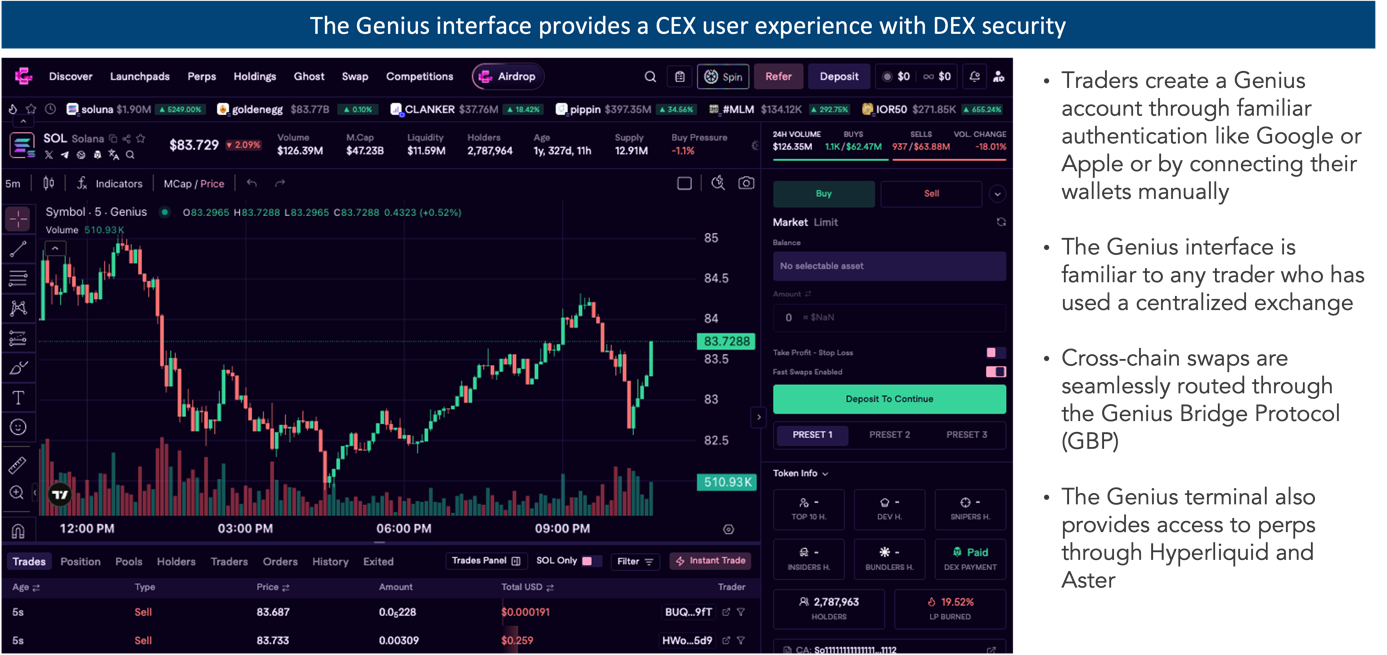
We see Genius as the missing link between the worlds of centralized and decentralized trading. Genius is an advanced on-chain trading terminal that enables traders to trade on 300+ DEXs across the largest chains in the ecosystem. The platform is built to deliver CEX-grade performance while retaining the security and non-custodial nature of its decentralized counterparts.
At the heart of Genius’ technology stack is the Genius Bridge Protocol (GBP). The GBP is an intents-based interoperability layer that coordinates liquidity across chains with different execution environments (e.g. the Solana Virtual Machine and the Ethereum Virtual Machine). Unlike legacy bridges that merely transfer assets from one chain to another, the GBP acts as its own universal liquidity layer by leveraging Lit Protocol to coordinate the flow of USDC on vaults across its supported chains.
When a user executes a trade, they submit an intent with a cryptographic signature. If the source token (the token the user sends) and the target token (the token the user wants to receive) are on the same chain, the trade is routed through a DEX. However, if the transaction is cross-chain, the GBP’s router module converts the source token into USDC and deposits it into a source chain vault. An Orchestrater wallet then immediately withdraws USDC from the target chain vault, swaps to the target token on a DEX on the target chain, then transfers it to the users’ address. In both cases, Lit Actions confirm the transfer to and from the associated vaults. Because the protocol only needs to verify the successful deposit and withdrawal from vaults, cross-chain trades using the GBP can execute with sub-second latency.
This unique architecture will enable a novel primitive. With the GBP, every token transfer between chains will become a value-add that can be extracted by the underlying protocol. When users deposit USDC into GBP vaults, they will receive usdGG, a fully-backed yield-bearing stablecoin that will represent a pro-rata claim on the protocol’s liquidity. Unlike traditional stablecoins that remain idle unless explicitly deployed, usdGG is designed to be productive by default. The same USDC that backs the token will be continuously used to facilitate cross-chain trades, earning fees from every transaction routed through the GBP. To amplify this yield, Genius plans to integrate M0 (a stablecoin platform) for capital efficiency, earning the prevailing T-bill rate on top of idle USDC.
Another unique primitive introduced by Genius is the “ghost order”. As we mentioned before, every swap that has ever been made on a DEX is forever stored publicly on-chain. Ghost orders circumvent this by leveraging multi-party computation (MPC), splitting large orders across hundreds of wallet clusters that execute swaps simultaneously. This technique hides the size and origin of trades while remaining cryptographically auditable and without sacrificing custody. Privacy at scale has long been a missing ingredient preventing DEXs from achieving high-value flow. We see innovations like the ghost order being a foundational element of the future of decentralized trading.
Over the coming months, ghost orders will evolve from its current implementation within the Genius Terminal interface into a fully protocolized privacy layer accessible via SDK. In its first iteration, ghost wallets will hide both the funding source and execution destination through multi-step bridging and intelligent routing. This allows users to distribute activity across large, whitelisted wallet clusters without relying on mixers.
By late 2026, this ghost order design will transition towards encrypted submission into a pooled execution contract. Here, trades are authorized through cryptographic proofs via zero-knowledge systems rather than through direct on-chain broadcasts. The role of the GBP then evolves into much more than a bridge. It becomes a funding obfuscator and the pool of resting capital that is used to solve private trades, denominated in usdGG. The result is a robust, long-term privacy framework that preserves composability and auditability while reducing information leakage and front-running. It brings institutional-grade execution discretion to decentralized markets.
Lastly, Genius directly addresses a core UX bottleneck that historically held DEXs back. Instead of forcing users to set up wallets and install extensions, Genius integrates Turnkey to support familiar web2 sign-in methods like Google and Apple, after which a resulting wallet is created in the backend tied to the user’s authentication method. In practice, this makes the wallet layer largely invisible. Funding the account is also simple. As expected, the platform supports native crypto deposits just like any centralized exchange, but also accepts fiat directly from major debit and credit card providers through Moonpay. By abstracting away the most failure-prone parts of DeFi onboarding, Genius reduces drop-off, broadens the addressable user base, and makes on-chain execution feel closer to a modern trading product than a task reserved for technical specialists.
Users are paying attention. Since the beginning of this year, Genius has accumulated over USD12bn in volume earning USD60m in annualized revenue from trading fees. The team is working on several new initiatives, including native transaction shielding as mentioned above and building out the first prop AMM on BNB (private liquidity pools run by professional market makers, expected in the second half of this year). To us, this roadmap signals a team executing with technical ambition and commercial focus. We look forward to supporting the team as they enter a pivotal phase of growth.
The YZi investment
At the beginning of this year, Genius made their largest announcement to-date. YZi Labs was joining us on the cap table, investing a “multi-8-figure” cheque into Genius. While the size of the cheque alone is significant, the broader strategic implications extend well beyond capital. YZi Labs is the USD10bn family office of Changpeng Zhao (CZ). CZ is one of the wealthiest people on the planet with an estimated net worth of USD79bn, a fortune he amassed by co-founding Binance, the largest crypto exchange. Notably, CZ also agreed to serve as a personal advisor to Genius, a level of direct involvement that is uncommon and underscores his conviction in the platform’s long-term potential.
Genius is building infrastructure that directly addresses the structural weaknesses of the centralized exchange model, the very model that underpinned Binance’s rise. That the founder of the world’s largest CEX is personally backing and advising a platform designed to make on-chain trading competitive with centralized venues is not incidental. It reflects a recognition that market structure is evolving, and that the future of trading will be increasingly decentralized, interoperable, and non-custodial.
For us, this is a powerful validation of the thesis we articulated nearly two years ago. Performance and decentralization are no longer mutually exclusive. Genius is demonstrating that on-chain markets can match centralized venues on speed, liquidity, and discretion, while preserving self-custody and transparency. The fact that one of the most influential figures in crypto has chosen to align with this vision reinforces our conviction that the industry is entering a new phase.
The Genius token is scheduled for launch in April this year. The platform’s meteoric rise has been nothing short of remarkable, validating our view that Genius has achieved product-market fit. We are excited about the trajectory of the business, with Genius positioned to be one of the defining platforms of this new era and a gem in our Digital Asset Fund portfolio.